Showing posts with label #addiction. Show all posts

Wednesday, November 4, 2015

Losing an Addicted Child -- Guilt Joins Grief

In my local network of grieving mothers there are a disproportionate number of us who have lost children to drug overdoses.

Most, if not all, were unintentionally fatal.

My son's autopsy, for example, says accidental overdose, although I know for a fact he intentionally overdosed, regularly. He just never expected to die from it.

For a while we wrestled with whether it might have been intentional, as he had made cryptic phone calls to family members during his last contact. But then again, when he was high most of his phone calls were cryptic in that we couldn't understand what he was saying or talking about.

Two facts blew that scenario out of the water. First, everything was always someone else's fault, so he would have been sure to leave a note with plenty of blame to be shared by everyone who he felt ever let him down. Second, his drug use had resulted in a certain level of psychosis in which he believed himself immortal. The fact that he had survived multiple Near Death Experience (NDE) overdoses, which are actually sought instead of being the frightening thing most of us would espect, and a car accident that should have killed him, only served to reinforce that idea.

All my personal baggage aside, loving and losing an addict, particularly when that addict is your child, carries a load of guilt and grief that is probably a common denominator.

The guilt can span a wide range of issues and is something I wrestle with in different ways regularly. At the same time, I expect I'm not alone when it comes to parenting and losing an addict. If you've walked that path, I want you to know you're not alone.

These are the questions we struggle with when guilt manages to find it's way into our thoughts. These are the questions we should be able to banish, but so often cannot.

"Why didn't I know?"

I knew he was using at the time he died, although I'm sure there were many times that we were together and he was high and I didn't know it. Initially, I thought he was just being a teenager and later I could no longer tell the drug moods from his own because I had lost the real person that lived in his body. I knew the drugs could kill him and I had told him as much, as kindly as I could and as often as I could. Sometimes I screamed it at him with tears. Sometimes it was a silent text message on his phone. Always it was with pain in my heart and with a belief that he would get better. I knew, but I didn't know, because I never really expected him to die. I thought he'd hit bottom and find his way back to living, but that never happened. I didn't know the reality of how that phone call would feel.

"Did I do all I could to help him?"

I never "sent" him to rehab. We all offered at one point or another, I think, to take him. We researched places and talked to him. But he never thought he had a problem, or at least a problem that he needed help to quit. Like any addict, his addiction controlled him and lied to him. He could quit for six months, so it wasn't a problem -- in his mind it was a choice. He wasn't even convinced it was a bad choice because he thought it made him smarter, godlike, better in some way. I suppose there might have been a way to force him into rehab, but it would have been a waste of energy and money. No one gets straight until they are ready to do so, as friends who have managed repeatedly tell me.

"What did I do wrong that caused it?"

That's one of those beat myself up questions that I tend to wrestle with way too often, even after I've successfully put it away time and time again. There's a million things I wish I'd done differently, but the simple fact is that I don't know that any of them would have made a difference. If that sounds like letting myself off the hook, then it's because I need to and so does any other person wrestling with that question. Despite addiction in our family tree that was not hidden, my son made the personal choice to experiment with drugs with his friends. They tried several things before he stumbled on the drug that did it for him and at least one of his friends and they became addicted. I don't think either of them came from bad homes or that as parents we considered each other's sons bad influences. Our boys grew up together and made bad choices together. My son died and I'm thankful her son was spared.

I could have lived somewhere else, taken him to church more, stayed in an abusive marriage to give him a father, not remarried, had a job with regular hours, put him in private school, more carefully monitored his activities, but all of those things are an illusion of control and I know it. I did the absolute best I could and if it was wrong, it was still his choice what to make of it. Parenting, at best, is often an illusion of control as though it were actually up to us how our children "turn out."

"Why couldn't I be enough?"

This one is tied closely to the previous one, but is more personal. If you love an addict, when they fall into addiction you feel like you should be able to love them out of it. That they choose the addiction over you, although in reality it isn't their choice. Even when I think I did the best I could with my life circumstances, I wonder if I gave enough of myself. Did I tell him how wonderful he was? Did I do enough to build him up? Did he know to the center of his being how much he meant to me? And if I did and he did, how was that not enough?

I caught myself with that guilt nagging at me the other night on my way home from the gym (alone in a car is a bad place to be sometimes). That's when my old Al-Anon training managed to raise its head and remind me that it wasn't up to me to fix anyone. That I had loved an addict before and managed to release the feelings of responsibility for his addiction and I had to do the same with my son, no matter how hard it was to do so. Reminding myself of that painful reality will eventually help free me.

As a sidenote, my first addict was my second husband, whom I'm often convinced God sent my way to prepare me to survive Ethan. Otherwise, I have to consider it all just a horrible waste of time and money. He went to rehab, but he didn't deal with his issues or overcome his addiction. I tried to do the things he wanted to do thinking I could make him happy and he'd quit. I bought into all the mind games an addict can play and was manipulated into being someone I wasn't a lot of the time. Al-Anon taught me that his addiction was his own and that I didn't control him. It also taught me that I'd know when I had had enough. I did, eventually find the time when I sent him on his way. (I'm sure he continued on in the same manner with his next wife. I didn't hear from him again until I got word he'd killed himself -- still wrestling with demons he could never let go.)

There's another kind of guilt I sometimes feel when relating to other mothers who've lost their children. Although no one believed my son had committed suicide, he did bring his death on himself. Sometimes I feel guilty because so many children die of disease while fighting to live, or are swept away in a tragedy no one saw coming. But while our circumstances of loss vary, how we feel afterwards is the same.

Grief at losing a loved one isn't unique. No matter how they left us, we are struggling to live with the loss.

There's a hole in our lives that is supposed to be filled, a person we're supposed to be able to reach out to and grasp with our hands, arms we should feel around us, a voice we should hear, even a smell that we'd recognize in a crowded room.

Grief at losing a child has a special edge. It's a loss out of sequence, as though there were rules to death. It's a future that we imagined that will never come to life, a family tree we expected to spring from our child wilted and cut down, leaving a wound in our lives that will never heal.

Thursday, October 16, 2014

My Happy Little Pill

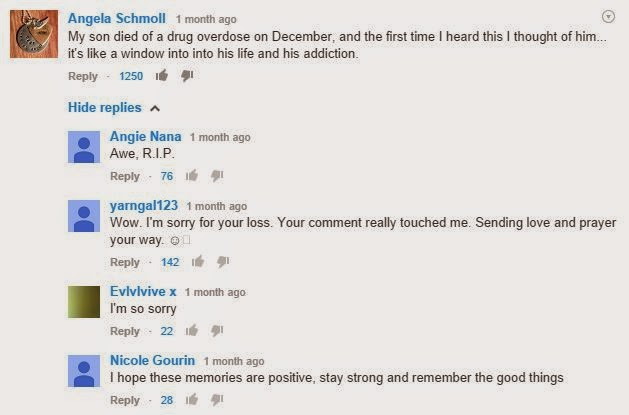
About a month ago I commented on a YouTube video for a song called "Happy Little Pill."

The song made me think of the way Ethan talked about his pills, the OTC cough suppressants he took to get high, to escape reality, to "be happy," or normal, or what passed for it in his addicted life.

The reaction I got to posting my short reflection on the song has made mine the top comment on what is essentially a teen emo song, supposedly about antidepressants, and has been as mixed as my own feelings, and what I expect are the general reactions of people around me, to what happened.

Most of the commentators, who I suspect are mostly teens or Ethan's age themselves, have expressed sympathy, hope that I cling to good memories, sorrow that anyone has to go through what we've been through, and too often understanding as they've also lost someone to drug overdose.

A few have told me how I should have fixed my son.

Several have told me I was surely a horrible parent.

All things I've thought myself at one point or another during the last 10 months.

No one should have to go through this. Young people shouldn't lose their siblings, spouses, friends and lovers to drugs. Mother and fathers, grandfathers and grandmothers shouldn't stand by the side of a grave on a hillside and mourn a life cut short. Small children shouldn't lose a parent, an aunt or uncle. Especially not to something as avoidable as addiction. Yet it happens, and when it does we try to cling to the good memories, even when we have to dig them from the layers of garbage that addiction makes of a person's life. Sometimes we have to hunt them like pirates' gold, following a trail through our memories and finally digging down to what may only be a single gold coin that we can treasure. Or we're able to keep digging, keep hunting, and find enough to make us smile.

I know that I couldn't fix my son, that I wasn't a horrible parent. But sometimes, I relive the choices I made day to day long before his addiction. Would this have changed his life? Sometimes I'm like a rat in a maze, trying to find a way through my life that doesn't have me emerging next to his cold casket. But I have to accept that I was working with what I had at the time and doing the best I could; that even before the drugs he refused efforts at counseling with an addiction counselor who could have helped him had he been willing to open up.

Maybe, if I had known the risk of what he was doing when he first started, or if whatever behavioral issue he had were diagnosed and addressed when he was young. But even then I couldn't do it. It would have taken professionals, and by the time I had a clue what he was hiding, he was so good at hiding it that the professionals couldn't make any headway. He was, at least legally, an adult and no intervention program could hold him when he didn't want to go. Even if it had, if he weren't ready to say I need to change, then he wouldn't have changed. He was never ready to say that except when he was straight for a long time and had no choice. Even then his resolve quickly crumbled when the world didn't become the place he wanted it to be and life didn't get better.

Only addicts and people that have really lived with an addiction understand that. I'm thankful for the time I spent in Al-Anon years ago while dealing with someone else's addiction. Those Sunday nights with others trying to cope with the insanity of their lives helped me understand the problem wasn't mine, I couldn't fix it, I couldn't discipline or rehab or counsel it away. It helped me to understand that it wasn't a choice of drugs over me, that it wasn't him talking when he was consumed by rage, that he wasn't in control any more either. That it was never a matter of him loving the pills more than me, no matter how it sometimes felt. It helped me understand how powerful addiction is and that being an addict and overcoming it are hard and require first admitting that it is a problem, that you need to change your life (not just stop) and that you may need help.

Ethan died knowing all the help he could ever ask for to beat his addiction was just a phone call away -- to me, his stepfather, his grandparents, his former pastor, his lifelong best friend, that young man's mother and probably a host of other people who knew and loved him and would have made sure he got whatever help and support he needed. He never made the choice to admit it was a problem and that he needed help to get better. He never thought it would kill him.

I run down this thread of thought because every time someone goes on YouTube and watches that video, if they scroll down a bit, they see the top comment and the number of people who have liked the comment and the long thread of replies to that initial comment. And every time someone feels they want to add to the conversation, I get an email telling me what they said, good or bad.

Some days it's ugly. It's the "Don't you feel like a failure?" or "You should have helped him" type comments. Most days it's an RIP, or someone else correcting the others in what is often a tone I'd only like to use. I could edit it, delete it, or disable replies, but I don't because someone may read it who has their own happy little pill. Someone may think twice about what it takes to bring color to their skies and decide they need help.

Someone may live and someone else may never feel what I feel.

At the same time, there's a part of me that watching the video, listening to the song, smiles because I know how Ethan would have reacted because it wasn't the angry, loud music he always chose. And yet, I think he would have recognized himself in the lyrics and listened anyway.

Thursday, June 19, 2014

Sometimes Love Requires A 'No'

Ever since I first said "No," to Ethan's addiction, I've struggled with balancing that "no" with mother's love and plain Christian charity.

Any mother or father who's ever had to turn away an addicted son or daughter's request for anything ranging from a few dollars to a place to stay for a few nights, or months, has felt that pain. Couple that with handing a few dollars to the homeless person on the corner who may well be using it to feed their own addiction, but doing it because of a desire to show Christ's love, and you'll get an idea of what I'm struggling with.

Add on the sudden death of that child who you've denied time and again -- not love or necessities, but other things -- and you can look for a boatload of guilt. A big ol' boatload of guilt.

In Sunday school this week one of the class members talked about loving without the "buts." Setting aside prerequisites on love and just loving, how he'd been able to do that with a person he was having trouble with and help that person, and I was in imminent danger of leaving class in tears.

Days later, I was still grappling with myself over whether my love had not been the quality it should have been. But there are no coincidences.

When an older gentleman who I've known for years called Wednesday needing a strong back (thinking of my husband) to move some items out of an office, I volunteered pointing out that toting 80 lbs. of granddaughters has given me a fairly good set of muscles. The deal was lunch, and during lunch I raised the subject with him as he's a sober alcoholic, a retired substance abuse counselor, and an Episcopal priest who has known my family for years and attempted to counsel Ethan at one time.

"I think you probably did for Ethan all he would let you do," he said, "because you're independent and I think you raised him to be independent."

Well, yes. He was right on those points. Pretty much the only things I turned him down for were allowing him to use and live under my roof (or a roof I provided) and his last request for a Playstation 4, an outlandish gift under the best of circumstances, but one that given the circumstances has plagued me all the same.

"I always saw these 45-year-old men who were calling their mothers to use their social security to bail them out," he continued. "When I was showing my ass and called my mother to go my bail, she told me to use my wonderful gift of gab and get myself out, that she wasn't responsible for my drinking. When I got sober, I thanked her for two things: the gift of life and making me take responsibility for myself."

His words brought me some comfort. Had Ethan ever managed to get straight, perhaps he would have been thankful for the same things.

Although he never achieved the independence he so craved, Ethan owned his addiction. He had a certain sense of warped responsibility about it. He shoplifted dextromethorphan rather than use money my mom occasionally gave him. He quite likely committed food stamp fraud to swap his food for drug money. He worked an odd job now and then if he needed money for pills. Sure, he'd use food stamps and take rent and utilities money from my mom (after exhausting my reserve of help), but he owned his addiction.

Still, it hurts that I couldn't do more for him. That he didn't ask for the normal things, like a good phone, new clothes, or his computer fixed -- the things I could have given him and been glad to do. Despite efforts not to, it bothers me that people probably judge our relationship not knowing the facts and decide I didn't love him enough.

Was I not a good Christian when I didn't do more? I don't know. The prodigal son's father never chased him down when he was living with the swine to make life better, so the only example I can find anywhere close doesn't say I was.

Still, when I give money to one of the homeless people I see so often in Winston, when I pray for them, it's in the memory of Ethan and who he might well have become had he lived life on the path he was taking. It's my love for him and for them as people who have their own struggles that makes me dig into my wallet instead of turn away.

Do they always use the money wisely? That isn't the question. The only question is whether we give in love.

And still wrestling with this question in the evening, I realized something else. Sometimes, even with love, the answer is "no."

We don't always give our children or anyone we love everything they want, addictions and other struggles aside. Sometimes we have to say no for their own good or because we simply cannot.

Sometimes, in this Christian walk, our answer is no as well, whether we are being asked or doing the asking.

If the answer were always yes, then I would have had the healing touch I sought and Ethan would still be with me today.

My limited, human, mother's love was right sometimes to say "no," because even with infinite love, the answer, sometimes, is still "no."


Thursday, June 12, 2014

Caught in the Circle of Grief -- Still, not Again

It's 9 a.m. on Thursday and I'm finally getting a cup of coffee.

I've been up off and on since the alarm went off at 5 a.m. for the girls to come (they came about 5:30, I really need to reset the alarm), they've had breakfast, been dressed, had their teeth brushed and hair arranged, and E1 and E3 had their morning brushing (therapy, more later) then we took E1 to her last day of Pre-K in public school (also a developing story line). The two little Es wanted more to eat when we got home. I've also let the kennel dogs out, cleaned cages for a couple who don't quite get waiting, fed the cat and carried out step two of sourdough bread making.

I think I deserve more than a cup of coffee.

Describing my morning and thinking how I'm floundering, how when the baby wanted a hug (and we give long, deep ones as a compression), I cried over her shoulder, I realize I'm not allowing myself time to process. Heck, life isn't allowing me time to process. My retreat from this blog, which I felt I didn't have time for (often true), has been like stopping therapy when I hadn't really accomplished my goals.

I'm not eating right, having trouble going to sleep, once again grappling with the idea that my 23-year-old son died all alone in his apartment, isolated in his addiction, and that we didn't even know it for days.

My mom bought me his death certificate last Saturday. It's still in the glove compartment of my car. She told me that in addition to the drug overdose which caused his death, he also had pneumonia. I haven't seen it. I cannot bring myself to look at it and to put a period on the sentence of his life that began with the birth certificate I have tucked away. Perhaps I'll hide it in the back of his baby book with his footprints and notes about his first teeth and first steps, with the lock of his baby hair and pictures of his cherub face -- here's how the story ended.

A friend of mine has his autopsy results. He works in emergency medicine and I thought would be better able to translate the terminology than I could. Plus, I wouldn't need to unsee and unknow anything. Ethan was mixing his meds, he said, and had a prescription painkiller in his system along with the chemicals from the dextromethorphan. Both were respiratory inhibitors. Both were toxic overdoses. We haven't had time to sit down together and answer any other questions. The day we had a meeting scheduled, there were multiple suicides back to back that he had to attend and I had to imagine the fallout.

I haven't processed either of those things. How does a 23-year-old with a heated home and the ability to feed himself wind up with pneumonia? Why did he think the meds he got from a friend to deal with the pain of the pneumonia were safer than going to a doctor? Why the bloody hell did he have to die all alone in his bathroom floor when so many people cared about him and he just wouldn't let anyone do anything that really meant something? How did the bright, beautiful boy I raised wind up so lost and hopeless?

Then we can move to the current generation of children. As a result of E1's late birthday and the effect her SPD has had on her small motor skills and emotional development, the decision has been made to redshirt her this year. Despite Mom changing her work schedule to better deal with school and her excitement about it, she won't be starting kindergarten as a 4-year-old in August. Instead she's likely to be attending a nearby church pre-K program the days she comes to my house so she won't be forced to sit home with the babies every day.

And a conversation with E1's therapist about her astounding progress (to us) and the fact that the one who had a tough time with beach trip was E3 resulted in the therapist suggesting SPD in the baby and all of us re-evaluating her change from a wonderful baby to a whiny, difficult toddler. She went for testing yesterday and it was confirmed. She starts therapy next week just as E1 is geared down to a semi-weekly schedule. The good news is the sooner it is detected the quicker she should respond to treatment and long term, because the adults in their lives learn management and they learn to recognize what's happening, they will be fine.

Because the disorder is genetic and because of the more than passing resemblance between E1 and Ethan in many photographs, I once again return to that disorder as something that slowly overwhelmed my son. Of course, there is no way of knowing, nothing that would show up on an autopsy or any of the many IQ and standardized tests he took while alive. It's just a feeling in my heart that had we known, had it even been a recognized and treated disorder 20 years ago, my son would have had the life he and I dreamed of and he deserved.

Then there is the fact that the schedule I'd grown used to, the one that worked for me and helped me keep my balance (perhaps I know where the SPD gene resided in my generation), has been disrupted not once, but twice. First my daughter takes the schedule shift, and the girls are no longer a part of my evenings every weekday, instead arriving bright and early every other week and by Thursdays leaving me stumbling through the day and with time to get things done on the alternate weeks (I'm not saying I don't like it overall, but it is adjustment). Then, just as I'm taking advantage of the free evenings to enjoy more time with my PiYo and Zumba companions, the studio closes for a month and I lose that entire fragile network of support where I'd been able to count on smiles and hugs and feeling for an hour or two that there were people around me who knew I was sometimes fragile and cared.

On top of that it's been so long since I've heard Ethan's voice, since I've felt his arms around me and his big bear hug, since I've heard him laugh or mimic my dad or put on one of the phony voices he'd use for fun. I may sleep in an old pair of his shorts, and keep his sweatshirt in a freezer bag to save the smell, and find myself unable to do anything with his old toothbrush, but I cannot reach him in any way. I cannot touch him and feel him. I cannot save him or myself from what happened or the path I'm now stumbling down alone.

Instead of just going on like none of those things bother me until I'm simply overwhelmed and crying on a baby's shoulder, I've got to start dealing with my grief again. If I don't give myself this time, somehow find a way to carve it out of days that feel impossible, then it's going to come back and bite me even though I thought I had it tamed.

As I've already realized, grief is a journey where the path loops back on itself time and time again. I can only hope the circles get bigger, instead of smaller like a whirlpool that sucks me down, because I know there won't be an end to the journey.


Thursday, May 1, 2014

Accidental Overdose Was a Seven Year Suicide

Last week, my mom called the medical examiner to see if she could get any results from Ethan's autopsy.

In a lot of medical terminology, it boiled down to accidental overdose.

It was no surprise, and yet the knowledge that he took a fatal dose of over-the-counter cough medication, something he probably always thought of as safe and something he could quit at any time, something most hardcore drug users probably laugh at, just really hit me.

Some part of me, perhaps, had been hoping there was some internal breakdown caused by long term use that could not have been easily averted. He had put his body through so much in 23 years, not just with the drugs themselves but with the seizures, falls and car accidents brought on by the drug use, that there was a chance that it was something else going on for which he needed medical care. He had complained about being in so much pain and hardly able to move, but had not wanted to see a physician. I don't know why that would have made it better in any way, or any more acceptable to think that it was less at his own hands, but at some level, apparently, it did.

Now it's been officially stated, cloaked in terms of toxicity and chemical names and tagged with the word accidental.

Without meaning to do so, without ever putting a gun to his head or blatantly saying "I don't want one more minute of living," Ethan killed himself.

It was a slow, seven-year march to death that began with taking more cough suppressant that the recommended dose. It progressed from making the local pool feel like jello, to psychosis and hallucinations of an alternate reality that were so real he sent texts to "friends" about what he was doing. It went from recreation to addiction and took over his life, crippling him mentally and physically in so many ways. It went from a for some reason desirable NDE (near death experience) to the real thing.

And I was powerless to save him. It was like watching someone drown in slow motion when you had thrown them a lifeline until your arms were tired, and it was still floating right beside them but they wouldn't grab on. It was like pulling them out and drying them off and breathing a sigh of relief, only to turn around and see them back in the water again, just out of reach and going under, but seemingly unconcerned that they weren't going to be able to breathe.

In some ways, it was like he drowned in six inches of water. If he'd only got up, he'd have been fine.

Accidental overdose. I don't know but what that's almost worse than if he'd done it on purpose. If he'd left us one last "damn you all and what you did to me" message in which he railed against life and everything in it, in which he'd tried once more to make us complicit in his choices, at least I'd have known it was a choice. Some people might find that worse, but to me this accidental label is so damn pathetic. He didn't mean to do it, like he never meant to do anything. Really. Every bad thing that happened in his life was an accident or someone else's fault. He could never own up to anything and this is one more thing he isn't responsible for.

After working four months to find some degree of peace with it, and despite the fact the pronouncement was what we all expected, it's made me hurt and most of all angry all over again.

Yes, I'm glad that he didn't commit suicide. Don't get me wrong. I'm sorry that his life was so painful for him and that he wanted to escape so badly that he just kept taking pills; pills that gave him a life inside his head where he was happier, and he needed just a few more to get wherever it was he thought he was going and that turned out to be "tripping" in the bathroom floor on some endless adventure in his mind that took him out of this world forever.

Perhaps knowing that he apparently died high and what he thought of as happy should be a comfort, but it's not.

The fact is, he was probably on that final high when he called me the last time. His speech, which was typically hard to understand when he was high, was so garbled I could only make out a word here and there. Even at that, I disappointed him yet again because I couldn't do what he wanted. I've wished a thousand times I'd said yes. But that wouldn't have made any difference because he was probably dying even then. His body was probably already in the process of shutting down as he made those final calls to me and my mom talking about a Christmas he wouldn't live to see. Or did my no mean he decided to take a few more pills, get a little further away? Would a yes have meant this pain was avoidable, or just a little further down the road?

Is the guilt that I find so easy to pick up the reason that I have wanted a different outcome on his autopsy? Probably.

But the simple fact is that Ethan's reality was painful and a promised Christmas gift would not have changed that, only postponed it with some new distraction. The reality is that Ethan did not see what was wrong with his choices. He did not see that the visions he was chasing were part of a journey that could only end the way it did. He did not want to change and although he could have been around for years more, without wanting to change, he would never have gotten up and saved himself from drowning. The reality is I'm not sure he would have ever wanted to change.

At the same time, as painful as it was living with his addiction, as selfish as it is to wish he had endured it longer, I wish I were still watching him drown and hoping he'd finally decide to get up and save himself.


Friday, March 28, 2014

Wrestling with My Guilt And Losing

When you lose someone to suicide or drugs, when they push the self-destruct button on their lives, it's much like a blundering suicide bomber has invaded a family gathering.

While they are the only ones who die, what's left are the walking wounded. We shuffle around one another trying not to step on someone's feelings and all suffering from the same emotional trauma. For the most part, we don't talk about our pain, or in this kind of death our guilt, because we know everyone else is hurting, and so what has already wrecked us becomes a wedge in our family.

We're all mourning the death of someone else -- a son, a grandson, a brother, a nephew, a stepson -- and at the same time each and every one of us thinks 1) that we should have been able to do something to save them or 2) someone else in the family should have done something differently. It tears us apart in a hundred different ways that go beyond the fairly simple fact of a death.

This morning I realized that often times by putting my thoughts into words I've been better able to deal with them, even if I wind up being repetitious, so I'm taking a stab at guilt -- beyond anger to remorse and a black tide that wants to swallow me whole.

Rationally, Ethan was an adult, free-minded individual who made his own choices. Telling myself that simple fact over and over does not change how I feel.

There are times when I'm drowning in regrets over things that, even had I done them differently, come with no guarantee of a different place today. Hindsight is not, as they say, 20/20.

So to get them off my chest, to perhaps find a measure of freedom from them, here's what I regret today, the questions that plague me:

Why did I let his father off the hook? No child support and no visits. Why didn't I force him into one and nag him into the other? Two weekends when Ethan was big enough to care hardly count as being a father. They lived only a few miles apart the last couple of years, yet... no, this is where I want to blame someone else and this is my guilt I'm wallowing in.

Why didn't I realize he was different in ways that needed help? Why didn't I recognize that the hesitancy and reluctance to enter a lot of situations meant there was something going on in his head that could have been corrected? Why didn't I force him to take some of the Duke TIP programs that would have stretched his mind beyond local friends and the boundaries of his school and home? Why didn't I insist on the AP classes when he started high school, so that he might have found more excitement in learning? Why didn't I do more to broaden his horizons beyond the two close friends who later traveled the path of addiction with him? (And now I remember encouraging him to go home with other kids after school and during the summer, I remember the arguments over AP classes, I remember how quickly he fled from the TIP brochure, how he sat silent during counseling sessions. I remember his joy in excelling at skateboarding with his friends, wild sleepovers when they were as normal as boys could be with dirt and sweat and random mischief.)

Why didn't I realize when he called me at work and I was on deadline and what he wanted to talk endlessly about wasn't even important to him, that there was probably something on the autism spectrum going on in his head? Why didn't I see that neediness for me and his general asocial behavior as a symptom of something more than just a teen uncertain about his direction and unwilling to follow the herd? Why didn't the counselors he did spend time with see through his brilliant bullshit and help me find the real problem?

Why didn't I realize that his friend wasn't experimenting with drugs alone? Why didn't I keep his room clean so I would have quickly found the evidence of what he was doing? Why couldn't I find the time to spend more time with him, even if it meant forcing him out of his world and into mine more often? Why didn't I learn to play the video games he liked once he cast aside the ones I could handle? (And I remember the fights, trying to clean his room and learn the games I couldn't understand, the frustration of watching who he was becoming.)

Why didn't I find a way to make him come home and do what he should have been doing at 16? Taking driver's ed, going to class, getting a job? (I tend to forget how hard I tried when I'm on my guilt trip.)

Why didn't I make him go to rehab? Never mind that I know it doesn't work until the person going wants it to work, and he claimed he never wanted to stop and never asked for help. At least I'd have the bills to assuage my guilt.

Why did I make him move out after graduating and finally getting his license? Why did I think making him take responsibility for himself would help? Why was I afraid I'd wind up like some of the murders I covered with a grieving son crying because he was drunk or high and shot his mother? Why do my most vivid memories often include his rage and my fear, and my uncertainty still over what might have happened?

Why couldn't I make him see what a wonderful, beautiful, delightful person he was when he was drug free? Why wasn't that enough to make him want to become that person all the time?

Why didn't I see him every chance I had? When he was in jail? When he lived only 10-15 minutes away? When I could have seen him or held him, why didn't I go out of my way to make it happen?

Why didn't I drive and get him more and take him to do things? Even if it meant a 30-minute drive and him deciding he didn't want to at the last minute, or not even coming to the door, so that I could just turn around, at least I'd know I tried.

Why didn't I say yes, I'd buy him anything he wanted for Christmas, even though he was virtually homeless and needed to be worrying about something other than a PS4, the last time we talked? He still wouldn't have gotten it, but that last conversation would have held a different place in my memory.

Why didn't I say do a welfare check or have it done myself when my mom was worried about him nearly a week before he was found dead? He was probably already dead, but at least I could have seen him to say goodbye.

Why couldn't love save him? Why couldn't I? Why weren't my prayers enough for God to heal him? Was I so bad that what I sought couldn't be given? Did I do something that punished my child in his life and me with his death?

There it is, my guilty questions that I pull out regularly for self flagellation. When I look at them rationally, there was really very little I could do differently. The boy/man I was dealing with wasn't some malleable person to be easily pushed and pulled in the direction I wanted him to go. I wanted him to think for himself, to be an individual, to make his own choices so they would be his to celebrate or regret. I did not know that although he proclaimed himself a loner, he was in fact a part of a very small, unhealthy herd and craved their support and companionship even more than being true to himself. I often think now that the failure to be true to himself was what killed him, what drove him to escape himself and travel a dark and ultimately lonely path to destruction.

When I look back at these things I have to remind myself that they didn't happen in vacuum where only he and I existed. When he was young, I had a tough demanding job that meant long hours but also kept a roof over our heads and food on the table. Then I was struggling with losing my career and trying to build a business to help pay the bills I'd always had money to pay. For years now I've worked 7 days a week and had no vacation. I've become a grandmother and been responsible for the workday care of three small children. I have a home, a husband, a yard, and in good years a garden.

I didn't know the hourglass of his life was going to run out before I had time to get through the other stress in my life. I always thought he'd get tired of the way he was living, instead of deciding that was the way he was going to live until he died.

I never thought he'd be gone at 23 and that all the love and life and laughter that he brought to every family gathering, that he could muster up for special occasions, would be gone.

I don't want to admit my powerlessness over life and death, and so instead I choose to wrestle with my guilt occasionally. I hope one day to put more of it away, but there will always be a bit left because I am his mother, and a mother takes care of her children, somehow, beyond rhyme or reason or even rationality.

That's the legacy of his death that I'll carry to my grave.


Thursday, March 27, 2014

Envious of Those Who Have What I Lost

We are told not to covet in the Bible, so I know it's wrong.

But sometimes, I'm so envious of mothers and sons that it hurts. I want that back, even if it is some "that" I never really had. I wanted those moments with my son, those moments stolen by bad choices and addiction, those moments forfeited to confusion and fear.

A group of healthy young men sitting together at church doing what healthy young men do can push me to tears. A mother hugging her son makes me turn away in pain. Boys of all ages make me want to reach out and somehow save them, but of course teens and young men are the worst. They bring back the loss along with the dreams.

I gravitate toward those wounded like me, those who have lost children, especially sons, to illnesses or sudden tragedies, or who are struggling with the knowledge that the phone call I got could be the one they get tomorrow. We huddle together when we meet, or we reach across the miles to one another through Google+ and Facebook and prop each other up as we try to stumble through our lives. We're like lepers, hiding our disease so we can blend in with the rest of society, but only truly safe and able to be ourselves when we are together and can let down our pretenses that life is anywhere near what we want it to be.

We're a secret society, like Masons, where everyone knows you're a member, but they don't really know what you do. There's no secret handshake or special ring to wear and we don't have benefit pancake suppers where the rest of the world gets to visit our special hall, but there's one hell of an initiation ceremony and it's a lifetime membership with dues paid daily.

We all wish we weren't members, but we wouldn't force anyone to take our place even if we had the option, because it's that horrible.

All the same, we look at other mothers with their "normal" children, particularly those at or near the age when we last held our own, and it's hard not to be covetous of someone else's life.

Sometimes that life is one we know only through that same social media that connects us with one another. It's a friend sharing the fact she's had a meal with her son, that her son is home from college for spring break, that he's getting married, or had a birthday. It's those little, everyday things we expected to happen or took for granted and never thought a thing about that break our hearts because they're as gone as the snow that fell earlier this week and vanished by midafternoon, leaving nothing but memories and mud.

Yet I know, even as I covet these moments of celebration, that they aren't the whole picture, and they may be hiding secrets as painful as those I once hid.

One of my new friends (a probationary member of the club who is still living a life where she clings to hope) posted a picture of her son's birthday not long ago. He was just a year older than Ethan would have been in a few weeks. The post made me cry, because he was here to celebrate his birthday and there was probably a family get together and hugs and love and all the things I miss so badly.

She messaged me a few days later that he was losing his battle with drugs again and the thread to happiness was unraveling.

It was easy, when I saw her happiness, to forget for a little while that fear she lives with every day. The fear I lived with for years; the fear that this time he won't come back and there won't be more birthdays or holidays or hugs or even tomorrows. Her honesty reminded me of all the pain, and I wouldn't trade places with her for the chance to hold Ethan one more time and then lose him all over again. The road this far has been too hard for me to ever want to start over.

So I watch other mothers hug their sons while my own ache to do so, trying not to envy them their moments when I don't know their reality or what their life holds. Instead, when I get the chance, I urge them to hug their children, boys and girls, and savor the moments because none of us knows how suddenly the future can be snatched away.

None of us knows when we'll be left with what we really had all along, our dreams and memories, our prayers and faith, and the task of making it through another day struggling to figure out what it all means with empty arms and no one to lean on but each other and God.


Friday, March 21, 2014

It's Just Medicine, Right? What's Wrong With That

Sunday evening I'm going to talk about my son's addiction at my church.

I sit down and try to think of what I'll say, and I feel like I don't know where to start, or how I'll get through it. But I know it's too important of a chance to pass up, because if just one kid understands the danger is real, or if just one parent or grandparent recognizes the threat, then it will be worth any emotional upheaval. It is part of who I need to be to go forward. Part of my purpose as Ethan's mom is trying to keep other moms off this same path.

I'll be following the local police chief who will be talking about the dangers of medicine abuse, but beyond that I don't know what he'll be saying. I just know I'll be putting a face on what, with him, will be something a step removed for most people.

But what do I tell them?

What were the first signs of trouble? What can they look for that I wish I'd seen? Will knowing make a difference?

I have to hope it will.

I still wish with every breath I breathe that I could put my finger on the moment things went wrong and change it somehow.

Was it the sad, wild little boy that quickly became one of his best friends in the second grade? Should I have looked at him like the rest of the world as a little boy whose daddy struggled with depression and whose mom tended bar and eventually left him and his dad for another man? Instead I saw a little boy who was lonely and who we could let into our lives sometimes, as long as he knew we had rules that he didn't have at home. We took him to the circus and let him stay over sometimes. When they were older, they went down the path of drugs and alcohol, huffing gas and petty crimes together.

Was it something in his behavior that I should have seen and sought therapy for when he was small even though he never had any problems before high school? He was just a smart, quirky boy, and I'd been a smart, quirky girl and I thought he was like me, fine with being the person that he was.

Was it his other best friend from a "normal" home? The boys were back and forth so much that I know there were times we felt like one extended family. His parents probably thought Ethan was the bad boy in their quiet, shy son's life. They went down the path of addiction together and only one made it out alive, and I've never had the nerve to ask whose idea it was to begin with, because I'm afraid it was my son's. And I would never blame the other boy if it were his, because they were just children really.

Was it when I let him not go to church because my parents had dragged me to church for almost 21 years? After I got married I didn't darken a church door except for Christmas and Easter because I resented my old church where all that was ever preached was salvation and once I had that, I didn't see the point. Ethan knew God, he was radiant on his baptizing day when he went below the surface in the cold mountain river on the first day of winter and emerged a new boy. I couldn't tell him there was more, because I had never learned it either.

Was it when he was caught shoplifting cough syrup and I practiced "tough love" because he was already out of control? The officer thought it was for the alcohol, although there wasn't enough to get drunk. If I had only known it was dextromethorphan and that it wasn't just medicine, it was a drug. Instead of a weekend in jail, would counseling have helped? But I didn't know about DXM then and what it could do. We both learned the hard way.

Was it me? Did I not try hard enough to give him boundaries while at the same time giving him wings? Because I never had wings, only a safe cage when I was a child and I so badly wanted him to have a different life. I didn't want my children to feel like they had to flee home to grow up. I wanted them to make their own decisions and sometimes make mistakes while they had a safe place to land.

Was it because I'd already dealt with addiction and realized it was beyond my control? So I never sent him to rehab when he didn't want to go. I never went through his room or his pockets and tried to destroy whatever it was he was using. I stood helpless on the sidelines as his life fell apart because I had prayed until I felt God was tired of hearing my supplications. I left it in His and Ethan's hands, because once it took root that's where it was all along.

Was it because even when I found the blister packs, when Ethan was virtually crippled by seizures from chronically overdosing on an over-the-counter cough medicine that he was shoplifting, I still didn't realize it was how addictive it was? I thought that once he'd pushed himself to a point where he saw a problem, he was still rational and intelligent enough to stop. I thought the seizures and the car wrecks and the psychotic breaks were bad enough that my smart, capable son would be able to quit.

Was it loving him too much? Always answering the phone even if he was in a rage and I was in tears when I hung up, or even worse in some ways when there was something so wrong that he was in tears and I couldn't understand what he needed; trying to treat him like he was normal and celebrating the good days and special times like we were still a real family.

The fact is that there was no one moment, but all those moments together. Things I couldn't have known would be a problem and things I couldn't or wouldn't change. At the same time, with more forewarning, I have to believe that people can make better choices and be more proactive. We cannot count on our children to avoid a danger we don't even know exists.

So as parents we have to be vigilant, even if things go wrong and ultimately we feel guilty and wish we'd done something different or something more. We cannot throw up our hands and watch a generation consumed by our society and its desire to escape reality with video games, drugs and paradoxically "reality" TV. We have to try to save our children, one by one, knowing that we may make the wrong choices and that ultimately what happens is up to them and God. We have to make sure they have God in their lives so that, perhaps, they will recognize that it's not just on them to straighten out all alone when things go wrong. And because if there is no healing for whatever is broken on this earth, we as parents can try to accept that they can find peace with our heavenly Father.

Beyond all that we have to know our enemies. They come in so many forms, so many lures that will take our children away from all of the bad times and let them forget who they are for just a little while, until they've forgotten for so long that they cannot remember. We have to know that they come not just in the wrappings of crime and bad neighborhoods, not just in dealing with people that they recognize from an early age are not folks they want to call friends. They come in the guise of friends, who offer them a safe escape. They come from the shelves of pharmacies, grocery stores and discount chains. Our newest enemy comes from our own homes and we give it to our children or take it ourselves not recognizing its potential for harm. It's medicine, prescription and over the counter, and we think it's safe and good. So do our children.

Somehow, in the end, that's what I have to say.


Monday, March 17, 2014

Cleaning Out a Flower Bed Is Like Recovery

Saturday afternoon, I spent a good hour or more reclaiming a flower bed.

It wasn't a matter of pulling weeds, I was actually pulling what started out as an innocent little vine in a container planting given me by a friend more than a decade ago.

The plant was variegated vinca minor and it seriously should come with a warning. It's almost as bad as the honeysuckle vines that insinuate themselves into everything. Maybe it is just my soil, or the fact that most of beds are set in perennials so I don't have to disturb them, but what was once a well behaved vine dripping over the side of large container had seriously run amok.

And I had let it.

As I pulled, dug and fought to clear it from around the azalea, dogwoods, irises, day lilies and hosta that are more welcome in the flower bed, it struck me that it was much like a bad habit, an addiction, sin even.

It started out innocently enough. It was pretty and caused no problems were it belonged. Kind of like indulging an all you can eat buffet or a cold beer now and then, enjoying a compliment from a coworker, experimenting with a drug -- it was nothing to worry about. It was enjoyable, attractive even.

Then it slopped over into areas where it didn't belong, creeping down the side of the pot toward the garden. That would be when you're eating the buffet every time you go out, getting drunk on a regular basis, flirting with the coworker, or beginning to enjoy getting high.

That's the time I should have nipped it in the bud. It would have been easy to pull up those few random strands that had taken root in the garden. But they weren't really hurting anything and I wasn't even sure they would survive the winter -- what potted plant does? So I left them and they lived and grew.

Like those bad choices, they were still manageable as long as I kept a close eye on what was happening. Each growing season I pruned and pulled and let them be the filler plants in my flower bed and they still didn't look bad. Their leaves were a pretty green and white and their flowers small and purple. They still seemed innocent and something I could control.

But last summer, the double whammy of a new baby to care for and the often less than spectacular weather mean that my careful monitoring of the situation lapsed. It was like the stress of life, which can cause you to drop your guard about that occasional habit you've allowed yourself to indulge in, and the next thing you know you're somewhere you never expected to be.

When I walked by the flower bed on my way to my future strawberry patch Saturday, all I could see was the vinca minor. It was draped over the top of the azalea, hiding the early signs of iris and day lily sprouts, masking any potential hosta growth. Without any attention for just a short time, it had taken over -- like finding your clothes don't fit and you don't remember how that happened, or that you've slipped into an affair with that coworker, or that you've got more than just a problem with drinking or drugs because you're addicted and your life is falling apart.

What really made me compare the vine to the problems of life was how hard it was to get rid of it. It wasn't just a matter of pulling a few plants like it would have been had I realized its potential for taking over. It was hard work and digging and pulling and damaging everything around it. It had kept the sun from the azalea, wrapped its roots around lilies, caused me to dig into hosta to pry it free. Good things, the plants I wanted in my flower bed, were damaged by its presence and injured by what it took to get it out. Because I had ignored its potential, it had taken over.

It wasn't pretty, it was ugly and overshadowed all the good and even after all my work and effort I know it's not really gone.

The flower bed looks good right now with the first signs of the plants that belong there peeping through the leaves. It's like our lives can look when we've lost the weight, ended the affair, finally gotten clean and sober. But that ugliness is still waiting to take over if we forget how easy it was to slip.

I'll have to spend all of this summer and maybe a few summers to come watching that flower bed and pulling the first signs of a variegated leaf or judiciously using a pesticide spray. I may even pray that the weather is in my favor, so that I have time to take care of it.

I know people who have worked so hard to get back to the life they wanted, then just want to enjoy it. Ethan was, I guess, one of those. He would get the addiction out of his life just like I did with the flower, purging it from all areas, and then whew, he was done. But it doesn't work that way. Keeping away from the drugs meant he needed to watch for any signs -- a new friend who was using, a desire to linger near them in the store, too much time alone thinking about how it used to feel to be high -- just like I've got to watch my flower bed. After months of being clean and wonderful to be around, of rebuilding the life he'd wrecked with drugs, getting his body back into shape and mending fences, he'd relax and soon we were all heading down that same path again. Until everything that was good in life was gone. Until he was gone as well.

It's the same for any bad habit. Even after you put in all the work and pain of getting it out of your life, making sure it doesn't make it's way back requires vigilance and a lot of prayer, because we're not really strong enough to do that kind of "weeding" on our own. It's not over when you quit, because that can too often turn into a pause, not actually stopping.

So I'll be keeping an eye on my flower bed, and praying for people who are trying to clean up their own weed patches, that we can all root out what is causing ugliness and hurting the things we care about, even if it means that we have to keep working to enjoy the beauty we know is there.

Friday, March 14, 2014

An Unexpected Gift

I don't have any "real" gifts from my son.

When I say real gifts, I mean the things we buy with money. When we grow up and start working and we want to give things to the people we care about -- sometimes just because and sometimes for special occasions. Sure, there's some compulsion there, some expectation, but we do it because we love them. Ethan never took his own money that he had worked for and chose to spend it on something for someone else.

He bought things he thought would bring him happiness -- video games and drugs. He "loaned" it to his "friends," people who never expected to repay him and found a spirit that wanted to help others but somehow didn't really know how, so was willing to give what he had to people who manipulated him.

The first Christmas after he had been in jail for a few months, when he was clean and working, he wanted to buy me a juicer. He told me to be looking for it because he thought I'd enjoy it and he saw it on TV and called and ordered it. But his credit card was overdrawn and I never got it. I still wish I had it. In fact I can sit down and cry over it a hundred times and probably will because one time he wanted to give me something.

The Christmas before he died he was living in a homeless shelter and the shelter director took the residents shopping for Christmas so he was able to buy, on someone else's dime, gifts for his nieces. Someone donated some items to the shelter and among them was a woman's football jersey in pink and white, but it was for the Carolina Panthers and he knew I liked football. He asked if he could have it as a gift for me. I know I'll treasure that second hand shirt with the wrong quarterback's name for the rest of my life.

I never received a Mother's Day card or a birthday card from my son, either. He never spent time standing in a card aisle looking for some commercial way to tell me he loved me. I don't know what part of him never felt that need to recognize a societal convention that way. I have no cardstock treasures to remember him by. He didn't even call to tell me happy mother's day or happy birthday. Ever. They were just meaningless days on the calendar to him. If the family had a gathering to celebrate he would usually show up, but last year that didn't even happen.

But as self consumed as he was -- and as all addicts tend to be -- when he ran into a need face on, he wanted to help. He'd scrounge through his cabinets to feed a stray dog or cat, or even birds when he had an apartment with a fire escape where crows sometimes lounged. If he ran into an older lady from church at the grocery store (when he was going to church) he's keep her company while she shopped, push her buggy and get things off of high shelves. The friends who used him pleaded needs he thought he was helping with, a little boy going hungry so he'd spend his food stamps on him and the friend would give him cash for drugs, if he got around to it; or a broken down car or insurance due that he could take care of with a loan of Ethan's meager savings, until there were no savings left, no money repaid and the friend was doing time.

His generosity though was for strangers. For me and his grandparents, he would seldom do a chore without expecting to be paid and then complain that he wasn't paid enough.

That disconnect within him is one of the things I struggle with sometimes. Perhaps there was a streak of Jesus in him that he gave himself away to others, but at the same time he was so miserly with the people who really loved him. And to be quite honest it just breaks my heart that I don't have something he thought enough of me to buy me, stupid as that may be. And among all the things I've been broken-hearted over the last three months, that is a small thing.

So when I opened a pink envelope in the mail this week and took out a necklace with his name, an angel's wing, a crystal that could be his birthstone, and the saying "I have an angel watching over me," I felt overwhelmed with the perfection of the gift. There was no card, but I had a hint who it was from and was able to confirm it later that night when we were actually both awake on opposite sides of the world.

A young woman approximately Ethan's age, since she graduated high school only two years ahead of him in Sydney, Australia, had sent it to me. I didn't know her before Ethan died, I'll probably never meet her or even talk to her on the phone, but we connected through Ethan's death, through my blogs about addiction and loss. We chat on Facebook and she asked if she could call me Mom instead of Angela, because... well, maybe because I need another child and she needs an extra mom (who doesn't sometimes).

Then last night, when I took it off to shower, the terrible dichotomy between what was and what should have been hit me and I cried and I'm still crying off and on. Ethan should have loved me and bought me things to touch and think of him. Ethan should be sending me hearts and hugs and messages on Facebook. Ethan should have given me something to hang onto before he left me feeling so lost and bewildered and wondering what the hell happened to my life and more importantly to his. Ethan should not have left me at all; he should have got his shit together and been the person he was meant to be.

At the same time, I have not been left with nothing as it initially felt.

Out of my loss, I've been given other gifts: friendships I would never have had; confidences I would never have shared; the chance to love people I would never have known; opportunities to help, minister to and support people I could not have reached. I try to put it in the balance and it doesn't replace my son, but then I realize that my son had his salvation and I know where he's gone, and perhaps in his journey or mine we'll be able to show someone else that direction as well. Because my tears and prayers are no longer just for the two of us, they're for what seems like a world of people facing the same pain and heartache, and the love that breaks my heart has also set it free to love as Jesus told us to love.

So I try to remind myself not just of the things I've lost, but of the things I've found, without and within.

My necklace is symbolic of all of that, even though the giver probably never knew the chords it would strike would run so deep. In a way, I know it is something Ethan would have wanted me to have, had he ever thought to give it.

My son never gave me any "real" gifts, but because of him I've received many gifts. One of them is a necklace.


Thursday, March 13, 2014

I Wish I Had Pictures of My Memories

I remember when this picture was made.

I was 29 and Ethan was near his first birthday. It was the first time he'd fed me, seemingly recognizing for the first time that I ate. It was a special enough moment that I asked his dad to take our picture, something I never did. I have virtually no pictures of me and my children because I was always behind the lens.

I remember how special that moment was and it came back to me in a rush recently when E3, now about the same age, insisted on feeding me some of her lunch. The feel of baby fingers pushing bits of food into my mouth and the delighted grin on her face were both familiar and pulled at my heartstrings.

But although that image feels real down to the weight of my baby's warm bare legs on my lap and the way the air felt in the drafty old farmhouse and my favorite cotton sweater, I struggle to remember my children's childhood. Except for rare moments, it seems a distant blur usurped by more recent ones of different children -- the three little girls who consume my days. There are too few photographs like this where I can remember the details because I was actually part of it.

Some of it is relative. Just as time seems to fly by as each day becomes a smaller fraction of the sum total of our lives, I think the time that I want to remember became a smaller portion of their lives as well. While I want to remember bathing and dressing small children and the heft of their little bodies and the way they smelled, those memories are mixed in with all the other memories and buried under the years.

With Ethan gone and no more memories to add, I want to recover more and hold onto them, and being unable to recall the exact moments I want breaks my heart. Looking at old pictures, much of the time I cannot remember the why or sometimes even the where. Instead, it's the snapshots I didn't take: the first time the nurse brought him to me after his difficult delivery and said I should nurse him and I was shaking so bad and in so much pain from surgery that when I tried to hold him I couldn't; the first day of school when the bus didn't stop at our new home because when they told the bus driver to get Ethan she didn't realize a new Ethan had moved into the house and she knew the previous Ethan had left; Ethan's motto which he failed to follow "Make good choices," adopted from DARE classes in elementary school; standing in the ER with a sweaty middle schooler who had just broken his leg using his skateboard as a luge, and who would have to wait six weeks for the shower he desperately needed; taking an afternoon off from work to ride around with him and his broken heart and wishing I could do more for the 16-year-old who was turning into someone I didn't know but still needed me when his world fell apart.

Even those memories are buried beneath the roller coaster of loving a child with an addiction, who would sometimes talk about the things he wanted to do with his life and for me, and sometimes curse me and the day he was born; alternately smother me in a hug that warmed my soul and hang up the phone when I was unable to provide whatever he sought, whether it was money or an endorsement of his point of view; the funny boy who mimicked his grandfather and the people around him and the scary young man who appeared on the edge of hurting anyone in his path.

Beyond all the pain of losing a child, which is like having a limb violently severed and being left with the phantom pain of hurting for something no longer there, I'm sure most of us lose track of what we want to hold onto about being parents.

The fact is that like most parents I failed to appreciate the everyday miracle of raising a child. Instead of moments to savor, it's something to survive, teetering between joy and exhaustion. Caring for our children and watching them grow is all mixed up with trying to make a living, advance a career, work out the give and take of a relationship and do the chores to keep our homes going. First steps and silly giggles compete with overdue bills and demanding bosses for our attention. We're often still growing and changing ourselves and discovering who we really are may keep us from enjoying every discovery our children make.

It's why grandparenting, even without having lost a child, is so much more intense than parenting. It's not about loving these new little people more, it's about having the time to appreciate them, seeing memories of other now grown children and the growing awareness of our own mortality. We're suddenly aware that every first we're experiencing all over again with them, may well be our last first.

Our children may see this kinder, gentler, more patient and generous person and wrongly accuse us of loving a grandchild more than we did them. In fact, it's a chance to love them even more. Baby talk and dimpled legs become at times not just your child's baby, but yours all over again with a deeper appreciation for each moment. We repeatedly realize how much we've forgotten of what is so precious to us, no matter how many photographs and home movies we make to save the moment, and we try to soak it all in like a dried sponge tossed suddenly into a bucket of water.

The photos, I realize, aren't really for us at all because the real memories are stored in our hearts and souls. They're for the little people, and their future little people, so they can see themselves from the outside when all they remember is how it felt to live the moment, so their children can look at Mommy at 4 and marvel about her hair and the fact that she was little.

My daughter has lots of pictures of her babies feeding her. I know because I've been the photographer at each first birthday party when they've smeared cake on her face and laughed with delight at the fun of mashing food. But I realize now that I need to hand someone else the camera more often.

I realize, looking at that old photograph again, that they are for the survivors of life, no matter who they wind up being. They help conjure the vague memory of the moment and reconstruct it into something you can hold in your hands and savor. When my granddaughters are looking for the pictures of their memories, I want to be in the picture. I don't care how I look any more when the moment happens. Whatever the future holds, I want them to have more than just their memories to remember it all.


Thursday, February 27, 2014

I Don't Miss My Son, Or Do I?

I don't miss Ethan.

The idea came to me Wednesday just in a flash and I thought, "How horrible!"

But it's the truth. With what feels like forty-thousand other things on my plate, from E1's SPD therapy to the baby's fractious behavior with cutting molars and my husband's broken arm, I don't miss Ethan's needs being part of what I have to deal with every day. In fact, I think if I had to deal with one of Ethan's meltdowns on the phone -- either anger or tears depending on whether he was using and what was going on in his life and head -- I think I'd just go ahead and check myself into a psych ward for a few days and let everyone else sort it out.

I don't miss his drama. Someone was always pissing him off and it was usually the person doing the most to help him. It could be the secretary or the pastor at the church where he had his shining moment as video production coordinator for about six months. It could be my mom or dad, who lived closest to where he had finally came to rest and tried to get him to doctors or the grocery store or pick him up for an occasional odd job. Sometimes it was me, and I guess he called someone else to rant and I didn't hear from him for weeks.

I don't miss worrying about his drug use and what it was doing to him. I knew he was using and lying because that's what addicts do, although he always denied he was addicted. He even asked me to print out his bank statement so he could settle a bill, and there was the evidence in daily trips to a dollar store where the OTC cough medicine he used was cheap and I could have probably done reverse math and figured how many packs he bought and used each time. When I finally told him I knew and just wasn't going to fight about it, it was a fight from his side in defense of how much better it made his life. We didn't talk for weeks after that and had just begun talking again a few days before he died.

I don't miss knowing that his life was so far from anything I could understand or have ever hoped he would have. That it was a grimy little apartment with video games, a guitar, and getting high, that he was always just one step away from a return to jail or the emergency room or homelessness.

I don't miss knowing that the smart, sensitive boy that I knew so well didn't really seem to exist any more and that the DUKE TIP and top student awards were just languishing in drawers, that college was probably never going to be his reality, that I wasn't even sure he'd ever be able to take time from fighting his demons to support himself.

I grieve for Ethan and the loss of the person I know he really was before all of the drugs and heartache buried him in such a shell of pain.

And there are things I do miss.

I miss knowing that I'll see him at his best at family events when he would clean up, sober up, and pull himself together long enough to endure it. Those get-togethers that felt like fun and hope to me probably felt forced and painful to him because there was probably always a part of him that just wanted to escape it all, just as there was a part that wanted to be accepted and stay forever.

I miss the occasional good phone calls, where something funny had happened that he wanted to share, or he just wanted to hear my voice or see how things were here. You have to understand, those were rare, but I always grabbed the phone when he called at a normal hour hoping that it would be one of those calls.

I miss his sarcastic sense of humor, him mimicking my dad's voice, which has been altered by a damaged larynx, or pretending to be someone else on the phone.

I miss his boyishness, although it worried me because it seemed his addiction had in many ways frozen him in time. Although he was aging, his dreams weren't adapting. One of the last things I bought him was a skateboard because he loved skateboarding before the drugs took over and he didn't have a board any more. He called and asked for one and it was expensive and I put off ordering it for a week or so, but finally did. It's at my house now, the wheels and deck scuffed with evidence that yes, he did use it although I don't think he ever told me he did.

I miss his smile and laugh and his beautiful blue eyes.

I miss watching him eat a chocolate-covered, cream-filled Krispy Kreme doughnut, or a piece of cake, or a Taco Bell burrito, or pizza, or huge plate of any of the foods he loved, because he enjoyed eating especially when it was a treat not part of his regular diet.

I miss the sound of his voice.

I miss his hugs when he completely enveloped me in his arms and often picked me up just to remind me that he was so big and strong and could pick up his momma.

So I guess, when it comes right down to it, I do miss Ethan. I'm just relieved that I don't have any of the bad parts to deal with this week.

But I'd take them all just to have his arms around me again.

Monday, February 24, 2014

Three Boys in Church

Three teenage boys sat in front of me at church Sunday.

It was awful.

They were laughing and talking together during fellowship time. They shook hands and were polite. During service they were attentive to the pastor, but also aware of one another and their place in the world. They were so full of life and potential. I wanted one of them to be mine.

Ethan should have been one of those boys. The problem is not only was he not one of them Sunday, he was never one of them.

He was never that comfortable in a new place, or even among extended family and probably seldom with his best friends. He never seemed to know for sure how to react, if he had the right expression on his face.

For a long time I've been haunted by a similar smile on his face and E1, a forced smile or a hesitancy that shows in the eyes. Now we know hers is a Sensory Processing Disorder. I suppose had we had such a name for it, his might have been another variety of the same disorder. Looking at the world a little differently. Experiencing the sights, sounds, smells and touches around them just a bit differently.

E1 knows already that she looks at things differently. I think Ethan had to figure it out on his own, but he didn't have the right label for it. He thought he was mentally ill, maybe crazy. E1 is going to occupational therapy to learn how to reorganize the way she sees things. He self medicated to shut out the sensations he couldn't control. We will help E1 learn to recognize and appreciate her uniqueness. Ethan knew he was different and wanted nothing more than to fit in.

"Ethan was always different. It was a good different. He was smarter, he saw things different," his best friend told me last week.

Without perspective, however, there came a time when he only wanted to fit in. Using drugs with his friends was a way to do that and simultaneously shut down the things he didn't understand.

He sometimes accused us of just wanting him to be like other boys. To be normal.

The sad part was that was what he wanted, too, far more than we did. He wanted to be like other boys.

He wanted to be one of those boys with their half-formed good looks, their leather jackets, jeans and cargo shorts and their self confidence, sitting on the second row in church.

When he couldn't find a way to be that, he found oblivion in drugs instead. As surely as he lost the things he was fleeing from, he lost himself as well.

Finally, we lost all that remained, the battered body that still could have been all of the things we all wanted him to be, had Ethan been able to be honest and accept the help that was so often offered.

Three teenage boys sat in front of me in church Sunday and I don't think any of my makeup survived the services. The sermon turned to Exodus, and I was Moses, put into a dark place to glimpse the glory of God, and it was the hardest church service I've sat through, ever.

I hope next week the preacher has a different topic. And I hope those boys sit somewhere else.

Wednesday, January 8, 2014

What Everyone Needs to Know

Before I went to bed last night, I took a dose of dextromethorphan. I've been sick for a month and I needed a dose of cough medicine so I could sleep.

The irony is, that I wish dextromethorphan didn't exist. Whatever the medical examiner eventually decides, I know it was dextromethorphan that killed my son.

If you're lucky enough to be like I was a few short years ago, you're likely to wonder, "What's dextromethorphan?" You might even imagine it was illegal or hard to obtain. You may feel like you don't need to worry about it at this point in your life. But whether you have children or grandchildren, or simply have kids that you care about, this is my educational course.

I usually keep some over the counter cold medicine around, and I'm willing to bet most people do. Maybe just the few pills left from the last round with a cough, but a partial box at least. Check the ingredients. If your medicine is designed to deal with a cough in any way, its active ingredients probably include dextromethorphan -- probably aboout 30 mg in a recommended dosage, which may be a couple of pills or a measure of liquid.

Yes, most of us have it, take it, buy it over the counter and keep it around the house. If we went to take a dose and that partial box was gone, would we really be certain that we hadn't taken it? If we found a few empty pill packets in the trash or while cleaning our teen's room, would we react like we would if we found a roach, a bong, or a bag of suspicious powder? Probably not. I know I didn't.

Once our better cough medicines were laced with codeine to quiet the hacking, although the last time I got it I had to sign for it and I'm not even sure it's available any more. Once codeine's more dangerous properties came to light, it became virtually impossible to get. That mean pharmaceutical companies, seeking ways to help us with our ills, had to have a new cough suppressant. Along came our new friend, dextromethorphan.

However the same agencies that eventually recognized the dangers and addictive properties of codeine have failed to recognize that a product designed to take its place carries the many of the same risks. It sits untended on the shelves of pharmacies, grocery stores, department stores, and even dollar stores. That's despite the efforts of StopMedicineAbuse.org and groups like them. Although you may have to present identification proving you are over 18 to make a purchase, there's nothing to keep a 13-year-old from slipping a small box into a pocket other than good shoplifting surveillance -- a fact that made dollar stores Ethan's favorite target until he racked up enough arrests for shoplifting that he could not get a job and feared incarceration.

The author of one of many pages dedicated to recreational, or as he terms it ritual use of dextromethorphan (erowid.org) writes that he discovered the drug through an accidental overdose by taking twice the recommended liquid dosage for a cold. That was in 1995 and he began to explore the use of the drug and publish his findings on the internet. There is a Facebook page called dextromethorphan hbr on which DXM abusers share their tips for how much to take and sometimes their writings while on a trip.

No, despite the fact that you may not know, that I didn't know, and that the police officer who arrested Ethan for shoplifting once did not know, there is a lot of information to be had about how to abuse dextromethorphan. There are multiple pages and blogs describing the misuse of dextromethorphan (as well as virtually any other substance you might care to learn about). You don't need an accidental overdose to find out you can get high on cough medicine, just an internet connection or a curious friend who has already done the research.

What does it do? I've asked.

Scientifically, when taken in excess dextromethorphan produces a dissociative or psychedelic effect. The effect is similar to the illegal drugs PCP and ketamine. Someone who takes dextromethorphan may experience hallucinations and strong feelings of euphoria. The effect typically lasts about the same length of time as the normal cough-suppressant effect of the medication, so a 12-hour cough suppressant will produce dissociative effects that last 12 hours in high doses. An increased dose does not cause longer-lasting effects, but it will cause stronger effects.

Ask someone who has used the drug, and you may get a better idea. I've talked to some of Ethan's friends who once used with him and these are the answers I've gotten.

"We used to think it was almost like giving us the knowledge of good and evil...like we suddenly knew everything. Everything we saw was a sign to us. It didn't take much for me to get high. I would only take about 4 pills, (not sure about dosage), and I felt like I was gliding when I walked. My eyes felt like they were widened, literally and mentally. I was never hungry, so I didn't eat much. This made me lose weight. I felt like I could stay awake for days and when I was coming down, I wanted to sleep it out. I found myself stumbling from time to time and stuttering while taking this drug. It made me feel warm. I could feel my body and heart slow down. I was always ready to get out and do something, yet at the same time, I was content with just sitting around because I could be with my thoughts and questions."

"I don't understand a lot about how far Ethan went with it. The way the drug works is if you take a little bit you just get high. the more taken, the more reality you lose. It changed me. The drug took something from me I'll never get back, or so I think. I'm not perfect, by far, but it's the worst drug I've ever taken in terms of effects. Even now, I'm paranoid because of it. There's something about me that will never be the same. It's something I like to hide in my past and don't like to talk about, but I want to help you understand how powerful of a grip it can have and had on Ethan."

A 39-year-old user on the Facebook page told me this: "So for me, at 24... I had 720 and went catatonic. Laid in bed. I felt paper thin and infinitely wide. Sensory matrix distortion. Tired. Like sleep. Now, I could have 1000mg in a 12 hour period and feel normal enough to walk, talk...not drive. I know NO study of longterm use. Honestly, in 2013 since March I have used an average of at least 240 / day... at night or in the morning. I will use it around people who are stressful or jerks because I can tune them out. Like family who will seem like total asses (partly because I am irritable etc) then on dm I see a lovable side and my pain doesn't get to take 1st place... I win. It's the drug I regret the least. Alcohol kills more, causes men to cheat, drivers to crash.(Although earlier in this tale he told about crashing his car) Adding caffeine to dm makes my heart race, so I dont. Benedryll helps a little at 25-75mg to sedate. Bededryll ALONE is like dm. I don't feel damaged after 290 straight days. So I wrote poetry n shit and read it to some girls in a bar crying. They were touched. Dm has helped my writing probably like drugs help rock stars..."

When Ethan was using, he lost weight and he was delusional. Sometimes what he said would pass for a really good imagination and sometimes it really didn't make sense. Often his behavior fit with the typical teen withdrawal -- he'd rather play video games alone than hang with the family sort of thing -- but sometimes his isolation went a step further. I didn't know what I was dealing with and what the symptoms could be.

From talking with his best friend I've found the extreme emotional spikes -- particularly rage -- are also common from teens/adults who are using regularly and at high amounts.

Anyone using dextromethorphan may also have trouble driving because the effects at low levels mimic alcohol, however if they are stopped by law enforcement, they can easily pass a roadside breath test. I know Ethan left my house high one day and was pulled over and passed a test. He also wrecked once while in the process of consuming the pills he preferred -- not just a double dose, but a pack or more at a time -- and frequently had minor accidents where he probably misjudged distances and struck trees, ditches, etc. When he died there was a pending lawsuit in the local courts from a collision where the other driver decided he needed money. He was without a license from blacking out while driving, striking a parked car and then going over an embankment. A toxicologist in the courtroom the day of his trial said he had a lethal dose of the medication in his system.

Aside from the psychological issues, and those associated with any addiction, there are physical risks as well. Some studies have shown there is a danger of developing brain lesions called Olney's lesions. These brain lesions affect memory, learning, and emotions. In some cases, the person will develop psychosis or epilepsy. Severe dextromethorphan abuse can lead to permanent lesions that cause permanent irreparable damage to the brain.

Ethan began having tremors and seizures more than three years ago. Sometimes the seizures were focal in that he could not completely focus or control his body and other times they were grand mal, in which he would fall in the posture we typically associate with a seizure. Although by that point I had learned that the drug would cause seizures, I also, naively, assumed once the seizures began that he would have enough sense to stop. He didn't. Had I known better the side effects, his gaunt face and continued rages would have told me that despite our regular doctor's visits to seek help for the seizures, he was still slowly killing himself. And it wasn't sense, it was addiction although many programs still don't recognize an addiction to dextromethorphan.

I didn't have a good grasp of the mechanics of addiction and still don't completely understand. However another article written by a former addict gave me some understanding. The drug of choice takes over the pleasure centers of the brain so that nothing else really gives an addict pleasure. The things you think of as good times are meaningless to them, even when they are physically with you. His writing is scientific, because he went on to become a neuroscientist, but does help explain what happens.

“... when drugs (or booze, sex, or gambling) are nowhere to be found, when the horizon is empty of their promise, the humming motor of the orbitofrontal cortex sputters to a halt. Orbitofrontal cells go dormant and dopamine just stops. Like a religious fundamentalist, the addict’s brain has only two stable states: rapture and disinterest. Addictive drugs convert the brain to recognize only one face of God, to thrill to only one suitor.” The addict’s world narrows. Dopamine becomes “specialized, stilted, inaccessible through the ordinary pleasures and pursuits of life, but gushing suddenly when anything associated with the drug comes into awareness…. I wish this were just an exercise in biological reductionism, or neuro-scientific chauvinism, but it’s not. It’s the way things really work.”

If I've scared you enough about the dangers of dextromethorphan, you may wonder what you can do. I don't have all the answers, but I do have recommendations:

Get as educated as possible. Do searches on the internet or even Facebook and don't settle for the science pages, but look at the addict's pages as well (although heaven knows they probably won't call themselves addicts). Learn the slang, the symptoms of abuse, the dangers of misuse. Be aware that most of the scientific sites seem to be out of date. There are not a lot of studies and it is wrongly assumed that young teen males are the most at-risk. That isn't necessarily true.

Talk to the young people in your life about the danger. Because it is not an illegal drug, most people wrongly assume it is safe even at dosages that exceed the recommendations.

Be careful with your attitude toward medication. Do your kids see you take double the recommended doses of anything? Like when your headache doesn't go away? If you take medication, follow the directions and make sure your children understand why. When you give medicine to your kids, do the same.

Consider keeping all medication under lock and key and explain that it is for the safety of everyone. You don't have to make your children feel you don't trust them. Maybe you have company with younger children sometimes, maybe you can blame it on protecting expensive prescriptions from thieves. You can come up with a way to manage the medicine in your house.

Watch not only your child's behavior, but that of his/her friends who may easily pave the way for your child if they get into trouble. If you're concerned tell your child that random drug tests are going to be part of your life. They could be the price for something they want to have or do, the risk of choosing friends you don't like, or you can point to someone else's loss and tell them you just want to feel better. Heck, blame me. Whatever it takes. Also be aware that dextromethorphan won't show up on standard tests but will show up on tests for PCPs and opiods. Yes, it's likely to create some tension, but it gives your kid a good excuse to say "no" when offered a little something and that tension is nothing compared to living with a kid on drugs. There will also be some expense, but compare that to seeking treatment for addiction, or perhaps the cost of burying a child.

Get involved in trying to get more people informed and laws changed. Visit StopMedicineAbuse.org or the organization's Facebook page and become a part of the movement to make a difference for our children and those not yet at risk. That means petitions, contacting congress and working to get laws changed so that this drug, at least, loses its illusion of safety and easy access.